AI Native Infrastructure - Systems Designed for Uncertainty
- Published
- Jan 18, 2026
- Authors
- Jimmy Song
- Publisher
- jimmysong.io
AI-native infrastructure is becoming the “underlying order” for enterprise AI deployment, but it’s not a simple upgrade from traditional cloud-native infrastructure. This book targets CTOs, CEOs, and platform teams, providing a definition framework for strategic decision-making, capability planning, and organizational alignment.
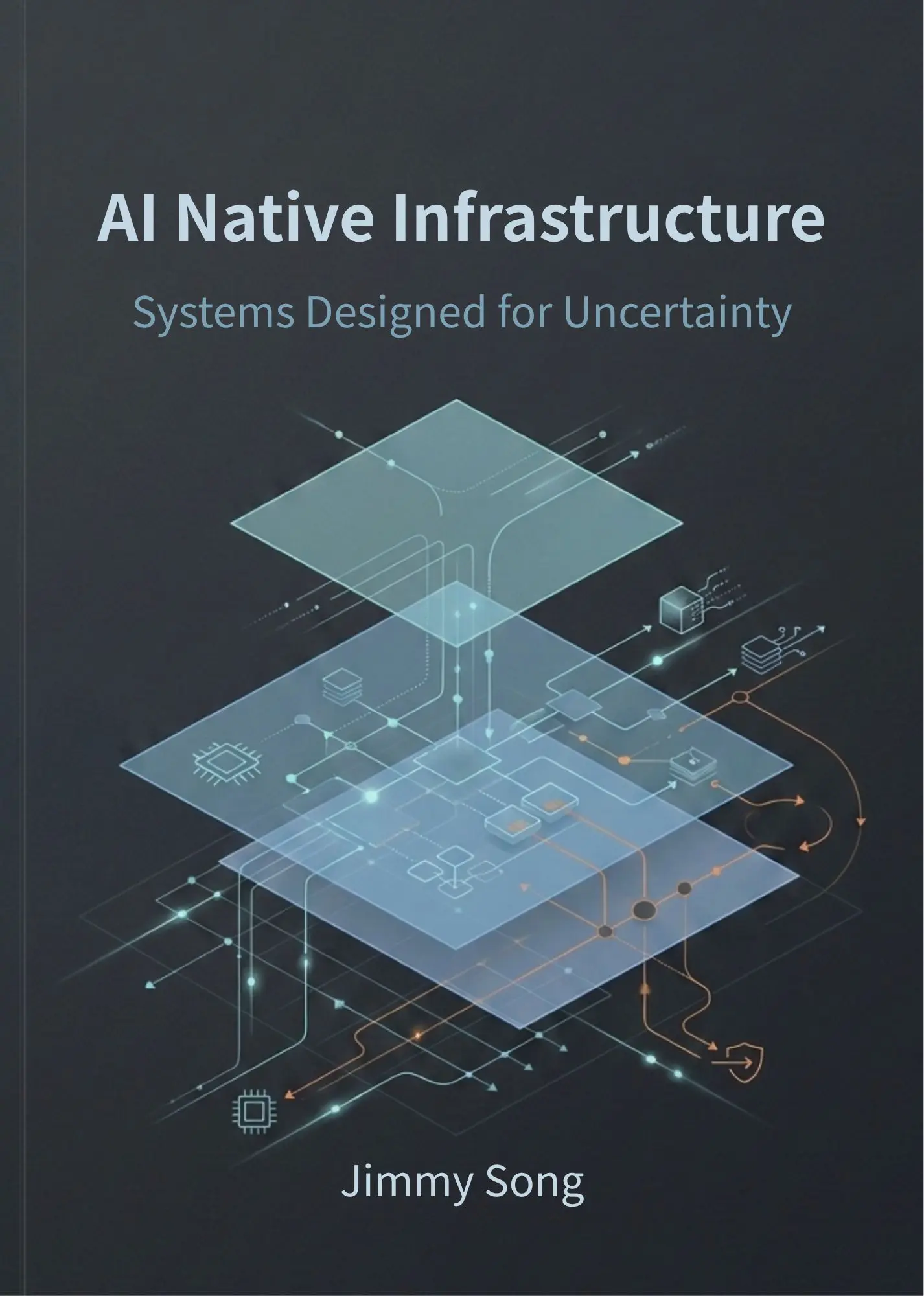
You’ll see three major shifts in AI-native infrastructure: models becoming “actors,” compute becoming a scarce resource, and systems being uncertain by default. Based on these premises, we’ll present a one-page reference architecture, governance principles, metrics and budget paradigms, and migration paths from cloud-native to AI-native.
Target audience: CTOs / CEOs / Technical decision-makers / Platform and infrastructure leads.
Sections
Part I · Definition
Core definition, boundaries, and evaluation criteria for AI-native infrastructure, focusing on model behavior, compute scarcity, and uncertainty governance.
One-Page Reference Architecture
Three planes (Intent, Execution, Governance) + closed-loop feedback for AI-native infrastructure architecture alignment.
Part II · Principles
Discussing Intent vs Consequence, why compute and cost are the first-order constraints of AI-native infrastructure.
Analyzing the closed-loop governance of metrics, budgets, isolation, and sharing in AI-native infrastructure, and explaining how SLO maps to cost and risk.
Part III · Organization & Migration
Redrawing boundaries across platform, infra, ML, and security, and transforming accountability and collaboration in the AI era.
An actionable roadmap for AI-native migration, covering bypass pilot, domain isolation, AI-first refactoring, and anti-patterns, with focus on governance loops and organizational contracts.
Appendix
Bilingual glossary of core AI-native infrastructure terminology for aligning organizational language.
Ten critical questions for CEO/CTO to evaluate AI-native infrastructure readiness.