What Is AI-Native Infrastructure?
The essence of AI-native infrastructure is to make model behavior, compute scarcity, and uncertainty governable system boundaries.
AI-native infrastructure is not a simple checklist of technologies, but rather a new operating order designed for a world where “models become actors, compute becomes scarce, and uncertainty is the system default.”
The core of AI-native infrastructure is not faster inference or cheaper GPUs, but providing governable, measurable, and evolvable system boundaries for model behavior, compute scarcity, and uncertainty—making AI systems deliverable, governable, and evolvable in production environments.
Why We Need a More Rigorous Definition
The term “AI-native infrastructure/architecture” is being adopted by an increasing number of vendors, but its meaning is often oversimplified as “data centers better suited for AI” or “more complete AI platform delivery.”
In practice, different vendors emphasize different aspects of AI-native infrastructure:
- Cisco emphasizes delivering AI-native infrastructure across edge/cloud/data center domains, highlighting delivery paths where “open & disaggregated” and “fully integrated systems” coexist (e.g., Cisco Validated Designs).
- HPE emphasizes an open, full-stack AI-native architecture for the entire AI lifecycle, model development, and deployment.
- NVIDIA explicitly proposes an AI-native infrastructure tier to support inference context reuse for long-context and agentic workloads.
For CTOs/CEOs, a definition that can guide strategy and organizational design must meet two criteria:
- Clarify how the first-principles constraints of infrastructure have changed in the AI era
- Converge “AI-native” from a marketing adjective into verifiable architectural properties and operating mechanisms
Authoritative One-Sentence Definition
AI-native infrastructure is:
An infrastructure system and operating mechanism premised on “models/agents as execution subjects, compute as scarce assets, and uncertainty as the norm,” which closes the loop on “intent (API/Agent) → execution (Runtime) → resource consumption (Accelerator/Network/Storage) → economic and risk outcomes” through compute governance.
This definition contains two layers of meaning:
- Infrastructure: Not just a software/hardware stack, but also includes scaled delivery and systemic capabilities (consistent with vendors’ emphasis on “full-stack integration/reference architectures/lifecycle delivery”).
- Operating Model: It inevitably rewrites organizational and operational methods, not just a technical upgrade—budget, risk, and release rhythm are strongly bound to the same governance loop.
A More Precise Layered Model: Paradigm Above, Refactoring Below
AI-native infrastructure should not be framed as a replacement of cloud-native infrastructure, but as a combined model of higher-level paradigm + downward refactoring.
- Layer 0 — Cloud-Native Substrate (retained): Kubernetes, container runtime, CNI/CSI, and observability primitives remain the execution substrate.
- Layer 1 — Resource Model Rewrite (core breakpoint): Scheduling semantics shift from CPU/memory-centric to GPU/token/context-centric; context and token become first-class resources. GPU virtualization, slicing, sharing, and oversubscription (such as HAMi) belong here.
- Layer 2 — Runtime and Control Plane Shift: Workload form shifts from request/response services to agentic loops, async multi-step workflows, and fused inference/training/evaluation execution paths.
- Layer 3 — Governance and Scheduling First: Scheduling becomes the primary control plane; deployment becomes a secondary concern under budget, risk, and policy constraints.
In other words: Cloud Native is the substrate, AI Native is the semantic override and resource-model shift on top of that substrate.
Three Premises
The core premises of AI-native infrastructure are as follows. The diagram below illustrates the correspondence between these three premises and governance boundaries.
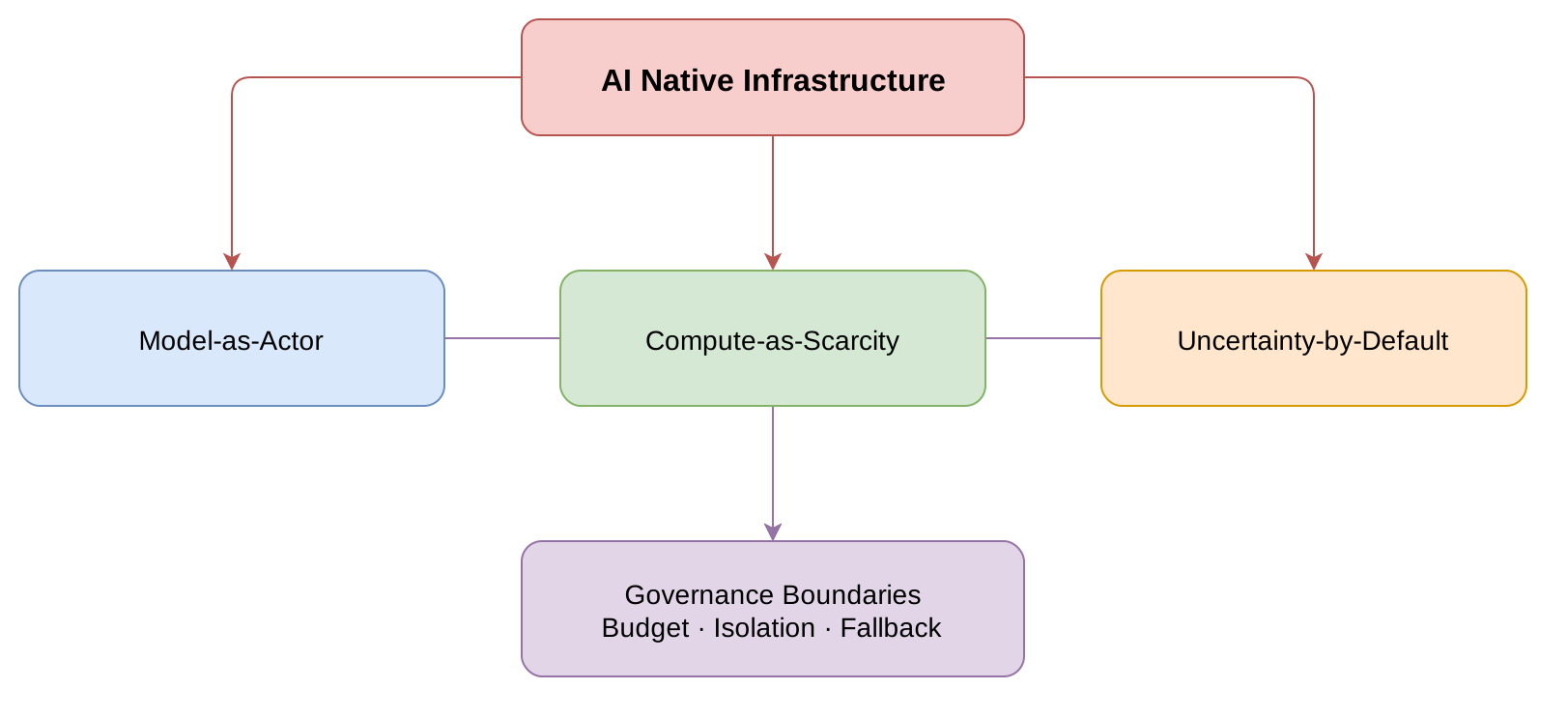
- Model-as-Actor: Models/agents become “execution subjects”
- Compute-as-Scarcity: Compute (accelerators, interconnects, power consumption, bandwidth) becomes the core scarce asset
- Uncertainty-by-Default: Behavior and resource consumption are highly uncertain (especially in agentic and long-context scenarios)
These three points collectively determine: the core task of AI-native infrastructure is not to “make systems more elegant,” but to make systems controllable, sustainable, and capable of scaled delivery under uncertain behavior.
Boundaries: What AI-Native Infrastructure Manages and What It Doesn’t
In practical engineering, defining boundaries helps focus resources and capability development. The table below summarizes what AI-native infrastructure focuses on versus what it doesn’t:
Not focused on:
- Prompt design and business-level agent logic
- Individual model capabilities and training secrets
- Application-layer product features themselves
Focused on:
- Compute Governance: Quotas, budgets, isolation/sharing, topology and interconnects, preemption and priorities, throughput/latency versus cost tradeoffs
- Execution Form Engineering: Unified operation, scheduling, and observability for training/fine-tuning/inference/batch processing/agentic workflows
- Closed-Loop Mechanisms: How intent is constrained, measured, and mapped to controllable resource consumption and economic/risk outcomes
Verifiable Architectural Properties: Three Planes + One Loop
To facilitate understanding, the following sections introduce the core architectural properties of AI-native infrastructure.
The diagram below shows the visualization of the three planes and the closed loop, facilitating rapid boundary alignment during reviews.
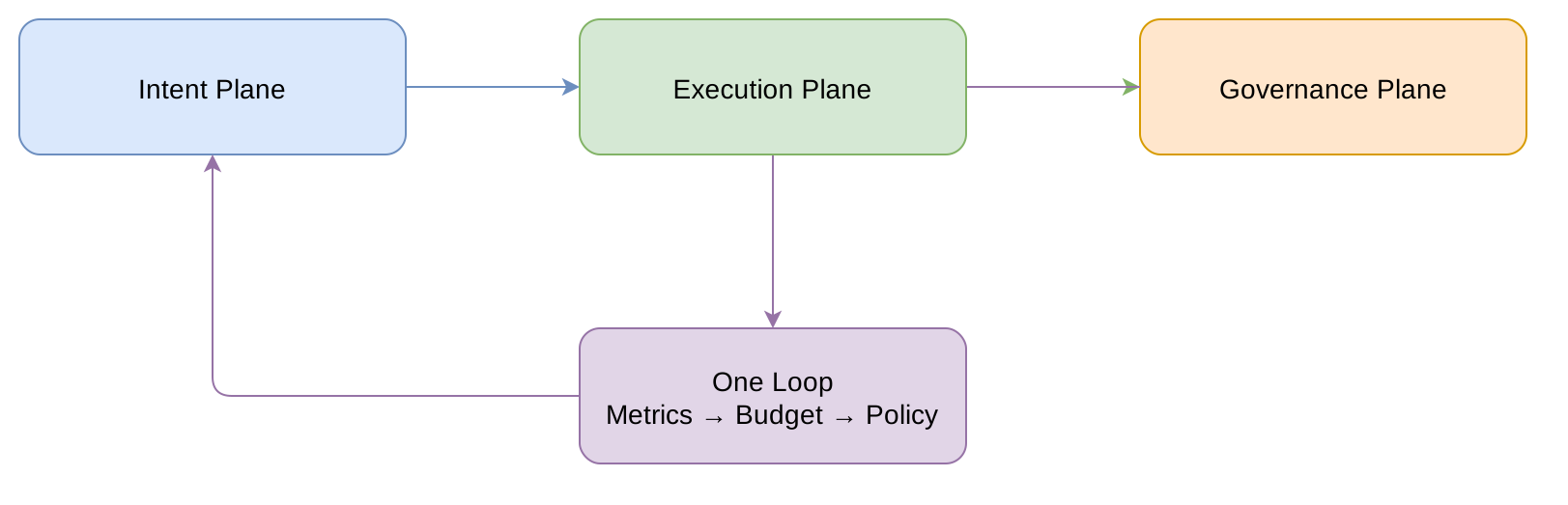
Three Planes:
- Intent Plane: APIs, MCP, Agent workflows, policy expressions
- Execution Plane: Training/inference/serving/runtime (including tool calls and state management)
- Governance Plane: Accelerator orchestration, isolation/sharing, quotas/budgets, SLO and cost control, risk policies
The Loop:
- Only with an “intent → consumption → cost/risk outcome” closed loop can it be called AI-native.
This is also why NVIDIA elevates the sharing and reuse of “new state assets” like inference context to an independent AI-native infrastructure layer: essentially bringing the resource consequences of agentic/long-context into governable system boundaries.
AI-Native vs Cloud Native: Where the Differences Lie
Cloud Native focuses on delivering services in distributed environments with portability, elasticity, observability, and automation. Its governance objects are primarily service/instance/request.
AI-native infrastructure addresses a different set of structural problems:
- Execution unit shift: From service request/response to agent action/decision/side effect
- Resource constraint shift: From elastic CPU/memory to hard GPU/throughput/token constraints and cost ceilings
- Reliability pattern shift: From “reliable delivery of deterministic systems” to “controllable operation of non-deterministic systems”
Therefore, AI-native is not a parallel track that replaces cloud-native, but a reinterpretation of cloud-native under AI constraints: the substrate remains, while resource, runtime, and governance semantics are rewritten.
Bringing It to Engineering: What Capabilities AI-Native Infrastructure Must Have
To avoid “right concept, misaligned execution,” the following minimum closed-loop capabilities are listed.
Resource Model: Making GPU, Context, and Token First-Class Resources
Cloud native abstracts CPU/memory into schedulable resources; AI-native must further bring the following resources under governance:
- GPU/Accelerator Resources: Scheduled and governed by partitioning, sharing, isolation, and preemption
- Context Resources: Context windows, retrieval paths, cache hits, KV/inference state asset reuse, etc., which directly affect tokens and costs
- Token/Throughput: Become measurable capacity and cost carriers (can enter budgets, SLOs, and product strategies)
When tokens become “capacity units,” the platform is no longer just running services, but operating an “AI factory.”
Budgets and Policies: Binding “Cost/Risk” to Organizational Decisions
AI systems cannot operate with a “ship and done” approach. Budgets and policies must become the control plane:
- Trigger rate limiting/degradation when budgets are exceeded
- Trigger stricter verification or disable high-risk tools when risk increases
- Version releases and experiments are constrained by “budget/risk headroom” (institutionalizing release rhythm)
The key is infrastructure solidifying organizational rules into executable policies.
Observability and Audit: Making Model Behavior Accountable and Observable
Traditional observability focuses on latency/error/traffic; AI-native must add at least three types of signals:
- Behavior Signals: Which tools the model called, which systems it read/wrote, what actions it took, what side effects it caused
- Cost Signals: Tokens, GPU time, cache hits, queue wait, interconnect bottlenecks
- Quality and Safety Signals: Output quality, violation/over-privilege risks, rollback frequency and reasons
Without “behavior observability,” governance cannot be implemented.
Risk Governance: Bringing High-Risk Capabilities Under Continuous Assessment and Control
When model capabilities approach thresholds that can “cause serious harm,” organizations need a systematic risk governance framework, not relying on single-point prompts or manual reviews.
Can be split into two layers:
- System-Level Trustworthiness Goals: Organizational-level requirements for security, transparency, explainability, and accountability
- Frontier Capability Readiness Assessment: Tiered assessment of high-risk capabilities, launch thresholds, and mitigation measures
The value lies in: transforming “safety/risk” from concepts into executable launch thresholds and operational policies.
Takeaways / Checklist
The following checklist can be used to determine whether an organization has entered the AI-native stage:
- Do we treat models as “agents that act,” not as replaceable APIs?
- Do we bring compute and budgets into business SLAs and decision processes?
- Do we treat uncertainty as the default premise, not as an exception?
- Do we have audit, rollback, and accountability for model behavior?
- Do we have cross-team AI governance mechanisms, not single-point engineering optimizations?
- Can we explain the system’s operating boundaries, cost boundaries, and risk boundaries?
Summary
The essence of AI-native infrastructure lies in: taking models as behavior subjects, compute as scarce assets, and uncertainty as the norm, achieving deliverable, governable, and evolvable AI systems through governance and closed-loop mechanisms. Only by engineering these capabilities can organizations truly step into the AI-native stage.
References
- Cisco AI-Native Infrastructure - cisco.com
- HPE AI-native architecture - hpe.com
- NVIDIA Rubin: AI-native infrastructure tier - developer.nvidia.com
- LF Networking: becoming AI-native is a redefinition of the operating model - lfnetworking.org
- NIST AI Risk Management Framework - nist.gov
- Google SRE Workbook - Error Budgets - sre.google
- OpenAI Preparedness Framework - openai.com